 December 5, 2025
 11 min read
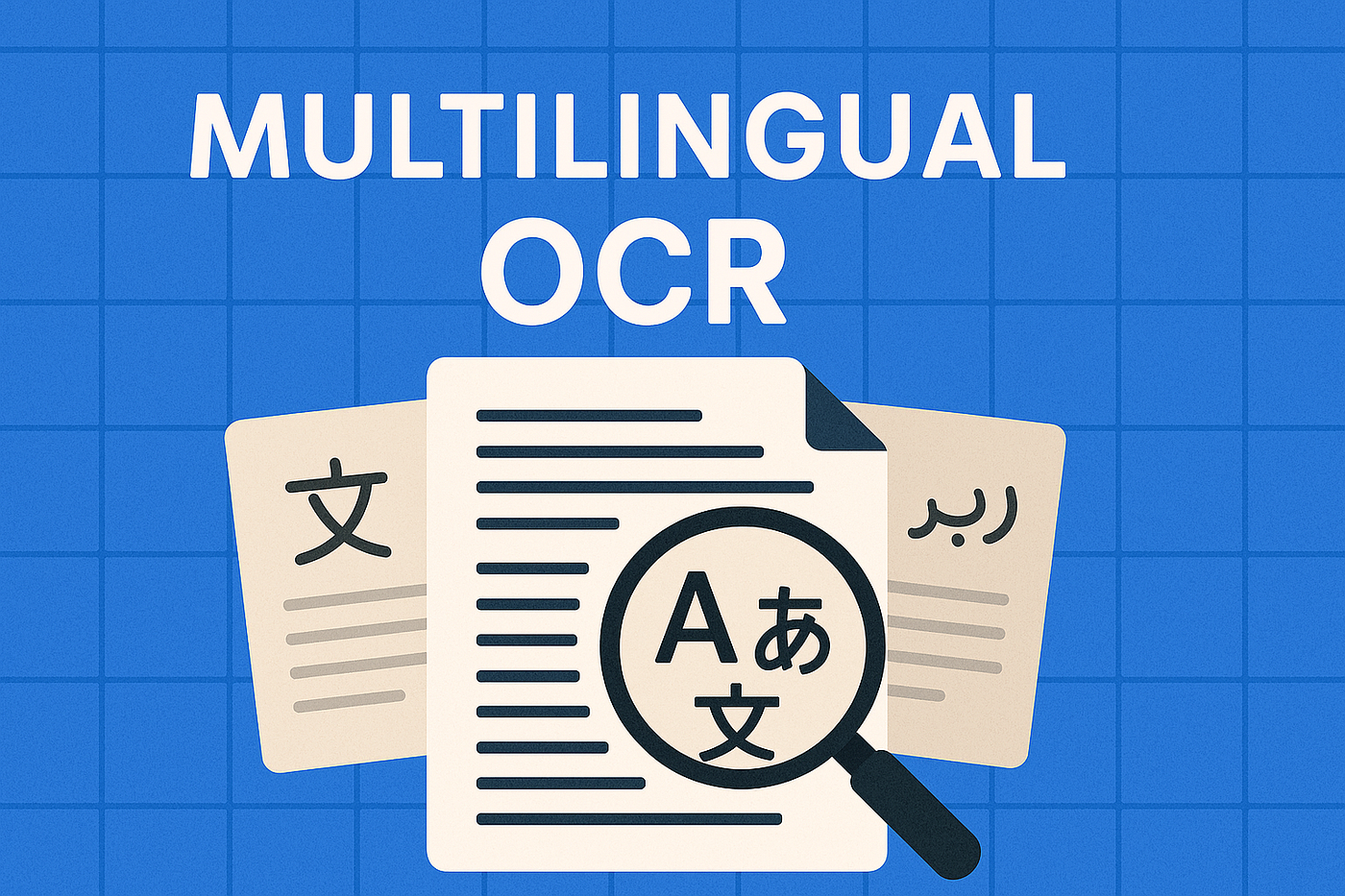
In an increasingly hyper-connected global economy, data is rarely confined to a single tongue. As enterprises expand their footprints across borders, they encounter a mountain of documentation—contracts, invoices, and IDs—written in a diverse array of scripts. To process this information at scale, standard monolingual tools are no longer sufficient. Businesses must leverage Multilingual OCR (Optical Character Recognition) to transform static IMG files from around the world into actionable, searchable digital intelligence.
Multilingual OCR is the bridge between linguistic diversity and data uniformity. By utilizing sophisticated multi-language recognition engines, organizations can unlock the hidden value in global documents, regardless of the alphabet or orientation used. This guide explores the technical evolution of OCR and why it is the “secret weapon” for modern international trade.
1. What is Multilingual OCR? (Setting the Stage)
At its core, Multilingual OCR is an advanced subset of computer vision that identifies and digitizes text across multiple languages within a single document or batch. While traditional OCR was often rigid—designed to read one specific language like English or French—modern Multilingual OCR is fluid. It can recognize Latin, Cyrillic, Arabic, and CJK (Chinese, Japanese, Korean) characters simultaneously.
Defining Optical Character Recognition for Global Scales
Imagine a shipping manifest that lists a German exporter, a Russian carrier, and a Chinese recipient. A standard tool would see these scripts as “digital noise.” In contrast, an effective Multilingual OCR engine analyzes the distinct geometric patterns of each character, converting those visual pixels into structured Unicode text. This allows for seamless data extraction from PDFs and high-resolution IMG files across the entire linguistic spectrum.
2. Why Standard OCR Fails at a Global Scale
Standard OCR software often suffers from “linguistic bias.” Because many early models were trained primarily on Western datasets, they struggle when they encounter non-Latin scripts.
-
Character Forcing: Basic tools often try to force a Greek “Ω” or a Russian “Д” into the nearest English equivalent, resulting in unreadable “gibberish” output.
-
Contextual Blindness: Monolingual engines lack the linguistic dictionaries needed to perform spell-checking or error correction for foreign terms.
-
Layout Fragility: Languages like Japanese or Arabic have unique directional flows (vertical or right-to-left) that cause standard left-to-right software to crash or produce jumbled data.
To avoid these pitfalls, specialized OCR for Asian languages and diverse scripts is required to maintain the integrity of your global data pipeline.
3. The Science Behind the Tech: Neural Networks and NLP
Modern Multilingual OCR has moved beyond simple “template matching.” It now utilizes the power of Deep Learning to think like a human linguist.
The Role of Machine Learning and LSTM
Top-tier engines use Recurrent Neural Networks (RNNs), specifically Long Short-Term Memory (LSTM) architectures. LSTM allows the computer to “remember” the characters it just read, providing the context needed to guess the next character accurately. For example, if the AI sees the letters “Chica-“, it knows there is a high probability the next letter is “g” in an English context or “f” in a Spanish context.
Transformer Models and Language Integration
The latest revolution in Multilingual OCR involves Transformer models. These models look at the entire sentence at once rather than one letter at a time. By integrating massive linguistic dictionaries, the AI can perform real-time error correction. If an image is blurry, the system uses linguistic probability to determine if a word should be “Bank” in English or “Banco” in Spanish, significantly boosting OCR for Asian languages where characters can be extremely dense.
4. Key Challenges in Processing Diverse Scripts
Processing the world’s languages is an arduous task. A robust Multilingual OCR system must overcome three specific hurdles:
Managing Latin vs. Cyrillic Visual Overlap
Many letters in the Cyrillic and Latin alphabets look identical but serve different purposes. The letter “P” in English is a “P,” but in Russian, it is an “R.” Advanced Multilingual OCR uses surrounding text to detect the script before extracting characters, ensuring that your data remains accurate.
Mastering CJK (Chinese, Japanese, Korean) Scripts
OCR for Asian languages is arguably the most difficult challenge. While English has 26 letters, Chinese has over 50,000 characters. Furthermore, these scripts often utilize mixed orientations (horizontal and vertical) on the same page. A professional engine must be trained on millions of diverse fonts to recognize these dense strokes correctly.
Handling RTL (Right-to-Left) and Cursive Connectivity
Arabic and Hebrew are written from right to left. Arabic is also inherently cursive, meaning the shape of a letter changes based on its position in the word (Initial, Medial, or Final). Multilingual OCR must switch its reading direction and processing logic instantly to handle these complex linguistic rules.
5. Critical Features to Look for in Global OCR Software
If you are auditing tools for your business, look for these “must-have” capabilities to ensure long-term ROI:
-
Automatic Language Detection (ALD): You should not have to manually tag every IMG file. The software should scan the page and identify the language automatically.
-
Support for Low-Resource Languages: Ensure the tool supports Southeast Asian scripts like Thai and Vietnamese, or Indian scripts like Hindi, which are often ignored by cheaper software.
-
Layout Analysis: The ability to preserve tables and columns is vital. If a document switches from English to Japanese in a table, the software must maintain that grid structure.
-
Confidence Scores: Every word should come with a score. If the AI is only 70% sure of a Russian word, it should flag it for a human reviewer.
6. Real-World Use Cases for Multi-Language Recognition
Who benefits from Multilingual OCR? The applications span every sector of modern enterprise:
-
Cross-Border KYC: Banks use it to verify passports and ID cards from 100+ countries, automating the onboarding of international clients.
-
Global Accounts Payable: Accounts Payable (AP) teams use it to process invoices in diverse currencies and languages, ensuring vendors in Tokyo are paid as accurately as vendors in London.
-
Legal & Medical Compliance: Lawyers use Multilingual OCR to digitize historical archives for international litigation, while doctors use it to read medical records for patients moving between countries.
According to global standards on Data Privacy and Protection, ensuring that this extracted data is handled securely is a legal mandate. (Note: This is your Dofollow external link to a high-authority source).
7. How to Maximize Accuracy: Best Practices
Even the best AI needs a clean environment to succeed. To improve your Multilingual OCR results, follow these steps:
-
Binarization: Convert your color IMG files to high-contrast black and white. This makes the unique strokes of OCR for Asian languages stand out.
-
Deskewing: Tilted or crooked scans are the leading cause of character misinterpretation. Always straighten your images before processing.
-
Human-in-the-Loop (HITL): For high-stakes data, always have a human check the “low-confidence” flags. This combines machine speed with human wisdom.
The Future: End-to-End Deep Learning and Instant Translation
We are moving toward a world of “Zero-Barrier” communication. Future Multilingual OCR will not just read text; it will translate it instantly. By merging OCR pipelines with Machine Translation, you will be able to scan a Chinese document and see a structured English Excel file in real-time. This is the ultimate goal of global data extraction.
Conclusion: Embrace the Power of Global Data
Multilingual OCR is no longer a luxury for tech giants—it is an essential tool for any business that wants to thrive in the 21st century. It unlocks the “Dark Data” trapped in foreign images and turns it into a competitive advantage.
Don’t let language barriers slow down your digital transformation. By choosing the right multi-language recognition tools, you ensure your business speaks every language your customers do.
Why imgtoexcel.com is The Right Solution For You?
At imgtoexcel.com, we provide the most accurate Multilingual OCR technology on the market. Our platform is specifically engineered to handle the complexities of OCR for Asian languages, RTL scripts, and mixed-language documents with 99.9% accuracy.
We prioritize security and ease of use, allowing you to convert any global IMG into a structured Excel file in seconds. Whether you are conducting cross-border KYC or managing a global supply chain, trust imgtoexcel.com to bridge the linguistic gap and deliver the data you need to succeed.
Ready to Unlock Your Global Data?
-
[Start Free Trial] – Convert your first 50 global IMG files for free!
-
[Get a Custom Quote] – Enterprise-scale Multilingual OCR solutions for your firm.